

The restaurant industry’s War for Talent has always been a tricky balance of finding the right people for the job and keeping them around long-term despite restaurant jobs being looked down on.
And the future of the restaurant industry’s labor market is a peculiar one, according to a couple of Statista infographics and U.S. Bureau of Labor statistics.
Employment for fast food cooks are expected to drop by 90,000 positions over the next decade; cashier jobs are expected to drop three times that amount. However, they expect an increase demand in fast food counter works and restaurant chefs over that same time period.
It’s all very confusing… such as trying to predict anything.
Cashiers and Fast-Food Cooks Jobs are in Jeopardy…
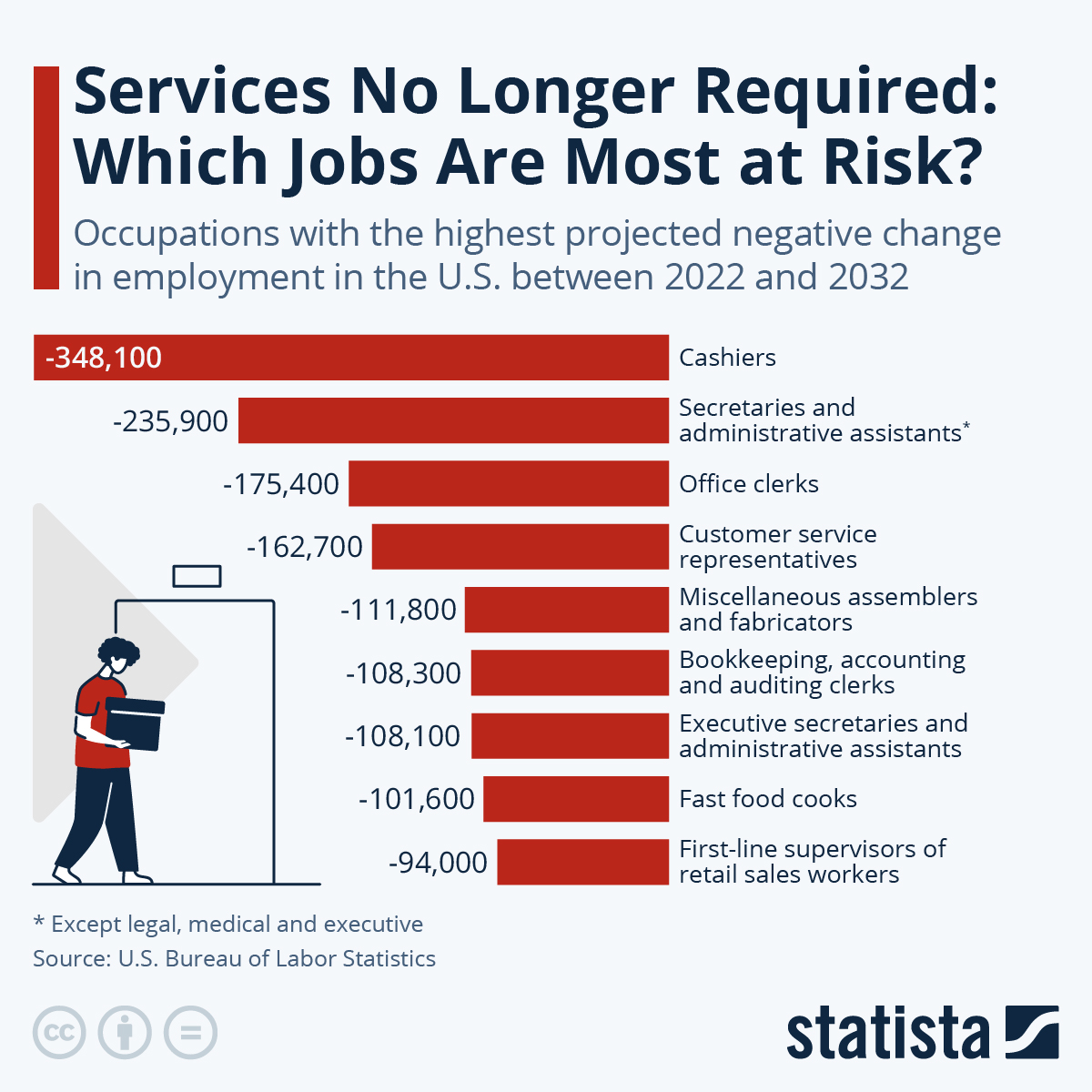 You will find more infographics at Statista
Seemingly on the chopping block are cashiers and fast-food cook positions.
This shouldn’t be too surprising. Fast food has always been a tech-forward sector of the restaurant industry, especially when compared to more traditional independent eateries. Many fast-food franchises, such as McDonald’s, have self-ordering kiosks at their locations. McDonald’s started rolling them out almost a decade ago. And while they still have traditional ordering at the counter, there are far more kiosks than there are cashiers.
These self-ordering kiosks bumped order totals by 11% for McDonald’s. And according to a Tillster report, 65% of diners want more kiosks, citing that they can review their order, make customizations easier, and find it more convenient.
Because of all that, U.S. Bureau of Labor Statistics are expecting cashier jobs to decrease by more than 313,000 over the next 10 years. Granted that’s all cashiers, not just fast-food cashiers. That’s still a lot of lost jobs.
Self-checkout kiosks, meant to replace cashiers, hasn’t been a wild success, leading to “customer frustration, dissatisfaction, and even rage.” So, we’ll see how accurate the Bureau ends up being.
However, the self-ordering kiosks have been a success and that would have any company looking for other ways tech and automation can improve things. Food prep and cooking are natural spots for execs to cast their eyes. And the U.S. Bureau of Labor Statistics seems to agree, expecting 90,300 fewer fast food cook jobs by 2034.
Fast food eateries, such as Dunkin’, typically have just one or two people manning cooking devices (glorified microwaves and convection ovens) that do most of the heavy lifting, using primarily pre-packaged food items from central kitchens/plants. This is in stark contrast to traditional restaurants that have several cooks making meals manually. More fast-food franchise may potentially run down that same road over time – if they haven’t already.
Ironically, one of the arguments in favor of the self-ordering kiosks was that it would allow employees to be transferred to other tasks, such as food preparation and cooking. So, it is amusing – in a very dark humor sort of way – to see the U.S. Bureau of Labor Statistics list fast food cooks in the top five occupations expected to see employment decline. That means just lost jobs all together, not employees being moved from one task to another.
…However, Restaurant Chef & Fast-Food Counter Jobs Expected to Grow
 You will find more infographics at Statista
What’s wild is that the U.S. Bureau of Labor Statistics also say that fast food and counter worker positions are expected to grow by over 233,000 over the next decade. Meanwhile, restaurant chef jobs are expected to grow by 217,000 positions over that same period.
So, what gives?
For starters, there’s no tech (currently) being implemented for the actual delivery of fast-food meals to guests. Someone has to bring the food from the kitchen to the counter, even if most of the cooking is automated. So counter worker positions could grow, especially if fast-food chains keep growing. The fast food sector is expected to increase from $972.74 billion in 2021 to $1.467 trillion by 2028.
Plus, someone needs to be onsite to fix kiosks that break down, etc. Counter workers may, over the next decade, morph into a general jack-of-all-trades position for fast food joints.
As for restaurant chefs, despite current economic problems, the restaurant industry is expected to continue to grow the next decade. The U.S. food service market size was valued at $1.2027 trillion in 2024. The market is currently projected to increase to $2.0662 trillion by 2032, nearly doubling over 10 years.
Independent restaurants are less tech-forward than their fast-food counterparts and haven’t embraced the same level of automation. Restaurants ride or die on the quality of their team’s chefs, so as indies grow, expand, and open up new eateries, so will the demand for quality chefs.
And if there’s fewer fast-food cooks out there, that’ll give operators more of a pool to pull from. Just have a good on-the-job training program ready to go.
The Human Touch

If these predictions are correct, we’re starting to see a huge divergence between fast food sectors and more traditional restaurant sectors. Or even more so than now.
Fast food is quickly turning to technology, automation, and “AI” to run their business. Everything – from initial guest order to counter delivery – will be almost entirely done by robots, machines, and computers. Fast food has always been about low cost and quick service and convenience; current technology trends may push that sector even further down the no-humans road.
Meanwhile, for guests still wanting that personal human touch, they may only be able to get it at traditional restaurants that still hire people to do the work. It’s a distinction that restaurant and bar operators should be mindful of. There’s always a lot of talk about needing new tech to improve one’s restaurant but what works for fast food franchises may not be what’s best for indies. Tech should alleviate pain points. If it’s not doing that, is it really necessary for your business?
